
Line to Lot: Dealers and Manufacturers Get Candid at the NATM Dealer Summit
| Session 1 Recap - Sales Team | Session 2 Recap - Beyond The Build | Session 3 Recap - Compliance |
NATM Dealer Summit Session 4 Recap
There are plenty of opportunities to hear from experts at an industry event. For the final session of the 2026 NATM Dealer Summit, the National Association of Trailer Manufacturers (NATM) wanted to hear from the people in the room."Line to Lot: The Dealer-Manufacturer Polling Panel" brought dealers and manufacturers together for a live, interactive conversation about the state of the trailer industry, what customers are asking for, where dealer-manufacturer relationships stand, and what both sides need from one another moving forward.
And the room was ready to talk.
The session was standing room only, with almost 200 attendees using their phones to respond to live polling questions throughout the discussion. Moderator Johnathan Bradley (All American Trailer Connection) did a wonderful job taking those results and turning them over to the panel for reaction, follow-up questions, and conversation.
The panel included dealers Ronnie Enns of Happy Trailers and Geoffrey Osborne of John Yoder Co., along with manufacturers Josh Johnson of Triple Crown/Down 2 Earth Trailers and Jacob Crabb of Diamond C Trailers.
Diamond C also sponsored the session, and NATM appreciates their support of an event designed to bring dealers and manufacturers into the same conversation.
NATM also thanks LaVanture Products Company, the overall Education Summit Sponsor, for supporting education throughout the 2026 NATM Dealer Summit.
Who Was in the Room?
Before getting into the bigger industry questions, Bradley started by finding out who was in the audience. One result immediately stood out: more than 45% of respondents had been operating a dealership for 16 years or longer. 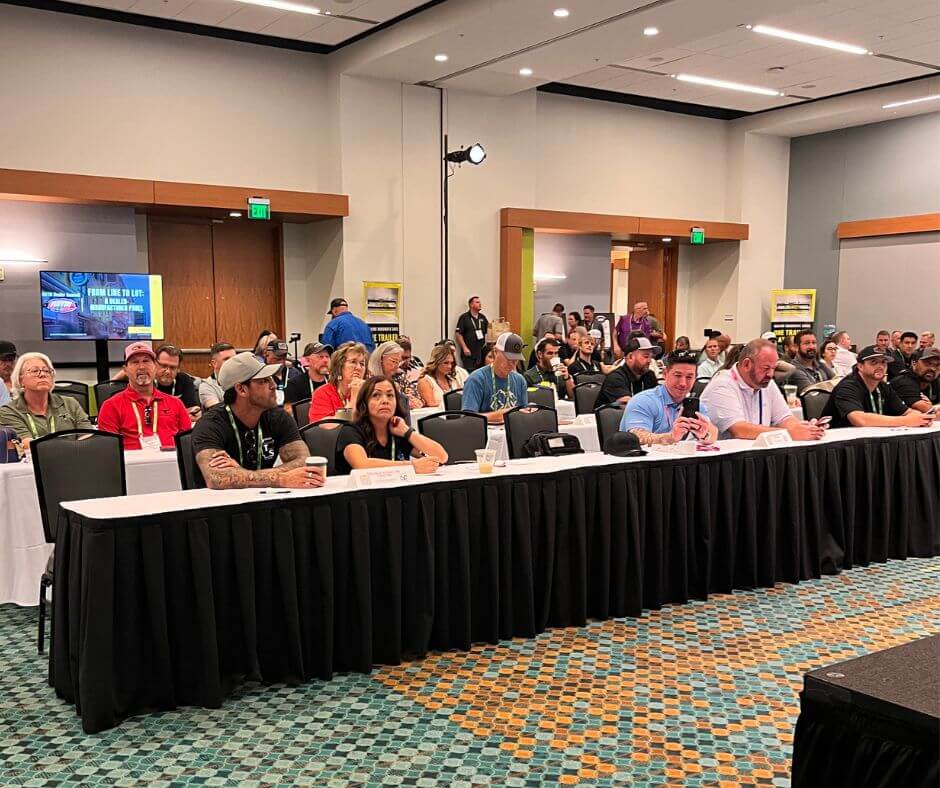
That experience made for a great group to ask some difficult questions about the industry. These were dealers who had worked through different markets, changing customer expectations, supply challenges, workforce issues, and shifts in the manufacturer-dealer relationship.
And while economic uncertainty and market demand topped the list of anticipated challenges for 2027, dealers weren't necessarily pessimistic about where their businesses stood. Eighty percent said their dealerships were performing about the same as or better than last year.
Manufacturers may have been especially interested in another result: 45% of dealers said they needed more inventory, while zero respondents said they had too much.
What Is the Customer Looking for?
When dealers were asked what customers are prioritizing most, price took the top spot, followed by quality. But the panel quickly added some context to those results.
Osborne said availability and customization often work together in his business, and when a customer wants something customized, price may no longer be the highest priority.
Crabb talked about another major change manufacturers and dealers are seeing: customers are spending much longer researching before they buy.
“Consumers are spending 60-90 days researching before buying as opposed to COVID times, which was 10 days,” Crabb said. “They are coming already knowing so much about the trailer.”
That changes the sales conversation. Crabb encouraged dealers to make sure their teams are well versed in their products and able to quickly connect the product’s value back to what the customer needs.
“Spend time doing sales training,” he said. “Learn to be quick and efficient with the value proposition.”
Johnson added another perspective: “There is a buyer for every trailer.”
The challenge is understanding that buyer and giving them a reason to choose your dealership.
A Changing Market
When asked which economic pressure was having the greatest impact on dealerships, 45% of respondents selected slower consumer demand.
The panel was seeing it too.
Johnson noted that dealerships accustomed to selling large numbers of utility trailers may see unit counts decline. Crabb turned the question back toward how businesses respond when demand slows.
“What are we doing to appear different or speak differently to the customer?” he asked.
Differentiation, product knowledge, customer experience, availability and value all became part of that conversation.
Workforce challenges haven't disappeared either. Enns pointed to higher turnover and increasing labor costs, noting the difficult balance dealerships face between controlling payroll costs and retaining good employees.
How Are Dealer-Manufacturer Relationships Doing?
One of the most anticipated parts of Line to Lot was the conversation about the relationship between dealers and manufacturers.
The polling showed a largely positive picture. Eighty percent of dealers described their manufacturer relationships positively, with about half of those respondents characterizing them as strong and collaborative. The remaining 20% described their relationships as either “meh” or strained.
The panel had plenty to say about what makes those relationships work.
“We are picky with our manufacturers, so we have great relationships with them,” Osborne said.
Johnson emphasized communication and working toward shared success. “The best dealers are partners,” he said. “We want to have a relationship and work together. Winning together. Communication is paramount.”
Enns encouraged dealers to raise issues sooner rather than later. “Take questions and concerns to the manufacturer early,” he said. “Don't wait to have the conversations. Address it before they become a big issue.”
Crabb suggested dealers and manufacturers establish expectations from the beginning and revisit them regularly, including through quarterly reviews.
That conversation connected directly back to the previous Dealer Summit session, "Beyond the Build," where dealers learned how to establish, measure, and manage manufacturer relationships.
What Do Dealers Want Manufacturers to Know?
One of the live polling questions gave dealers an opportunity to answer openly: If you could ask manufacturers for one thing that would help your dealership be more successful, what would it be?
Responses included consistency, availability, hands-on training, stronger dealer representatives, and better support.
But some of the answers went deeper.
Several dealers said they wanted to feel appreciated by their manufacturers. One response was especially pointed: “We are a top 10 dealer, but you don't care.”
It was a short answer that generated a much bigger conversation about what dealers need from their manufacturers beyond product.
Enns said some manufacturer-dealer relationships remain largely transactional and that both sides have room to expect more from each other. He pointed to adjacent industries such as RV and motorsports as areas the trailer industry can watch and learn from.
Crabb said support also has to be based on what an individual dealer actually needs.
“It's important to see what your dealer actually needs,” he said, explaining that the answer won't necessarily be the same program or incentive for every dealership.
Training was one example. When Bradley asked how dealer training has affected the manufacturer’s business, Crabb said it has been impactful and that investing in the dealer's sales force has been valuable.
Quality, Availability and Doing Your Part
When the conversation turned toward priorities, availability came up repeatedly.
Johnson explained that customer expectations have shifted from the days when more trailers were built to order. Today, he said, customers increasingly operate with an “I need it tomorrow” mentality, making availability a driving factor and an area where his company is investing.
For Crabb and Diamond C, product improvements have also been a priority. He talked about investments in better components, paint, lighting and other areas that may reduce the burden on service departments while ultimately creating a happier customer.
Osborne brought the conversation back to quality, identifying it as his number one priority and an important part of his dealership's success.
Enns also challenged manufacturers to thoroughly test products before they reach dealerships. “The manufacturer needs to test the product,” he said. “I don't want to see the beta of a product, not just for durability but for safety.”
For a Summit centered on giving dealers a stronger voice in industry conversations, those exchanges were exactly what NATM hoped the polling panel would create.
Where Is the Industry Headed?
Bradley didn't shy away from some of the larger questions facing dealers, including pricing and consolidation.
On pricing, Johnson cautioned that one size doesn't fit all, even as manufacturers work toward consistency. Crabb said Diamond C likes the idea of Minimum Advertised Price (MAP) pricing, while acknowledging the industry has work to do before getting there.
Enns questioned whether a true one-price model could work across an entire industry.
The panel also discussed manufacturers purchasing dealerships and whether dealer consolidation will continue.
Enns acknowledged that manufacturer ownership of dealerships is likely to continue growing, but maintained that dealers bring a specialized skill set to the equation. “I believe a dealer is a better dealer than a manufacturer,” he said. “It's what we do.”
Johnson said he expects consolidation to continue and pointed to opportunities to reduce overhead and become more competitive. Crabb also expects continued consolidation, noting the private investment already entering the industry and the ability for larger organizations to invest in broader initiatives such as marketing.
Keeping the Conversation Going
By the end of "Line to Lot," the poll results had become almost secondary to the conversations they started.
Dealers talked about customer behavior, inventory, workforce challenges, pricing, quality, manufacturer support, training, and the future structure of the industry. Manufacturers had an opportunity to respond directly and explain what they are seeing from their side.
There wasn't always agreement — and that was okay.
One of the goals of the NATM Dealer Summit is to create opportunities for dealers and manufacturers to hear directly from one another. A standing-room-only crowd willing to answer candid questions and a panel willing to dig into the responses made "Line to Lot" a fitting way to close the day.
Crabb offered one final thought that applies to manufacturers and dealers alike as technology continues to change how businesses market and communicate with customers:
“Today, authenticity wins over AI. Stay true to why you do what you do.”
NATM appreciates Johnathan Bradley for skillfully moderating the discussion; Ronnie Enns, Geoffrey Osborne, Josh Johnson and Jacob Crabb for bringing their perspectives to the panel; and every dealer who participated in the live polling and helped drive the conversation. This will be a session that NATM looks forward to keeping at future NATM Dealer Summits.
| Session 1 Recap - Sales Team | Session 2 Recap - Beyond The Build | Session 3 Recap - Compliance |
The NATM Dealer Summit focuses on education to help dealers strengthen their businesses, build partnerships, and address industry challenges. The summit aims to provide valuable insights, meaningful discussions, and actionable ideas for attendees, covering leadership, compliance, and the industry's future. It's an opportunity to extend the educational experience valued by NATM members to a broader audience at the NATDA Trailer Show.